%20Logos.png)
If you have been dealing with pain for a while, you may know this cycle well.
You hurt.
You worry something is wrong.
You try a treatment.
You get some relief.
The pain comes back.
You start searching for the next person, the next technique, the next scan, the next explanation, or the next thing that will finally “fix” you.
If that sounds familiar, I want you to know something important:
I do not think your pain is fake. I do not think it is “all in your head.” I do not think you are making it up.
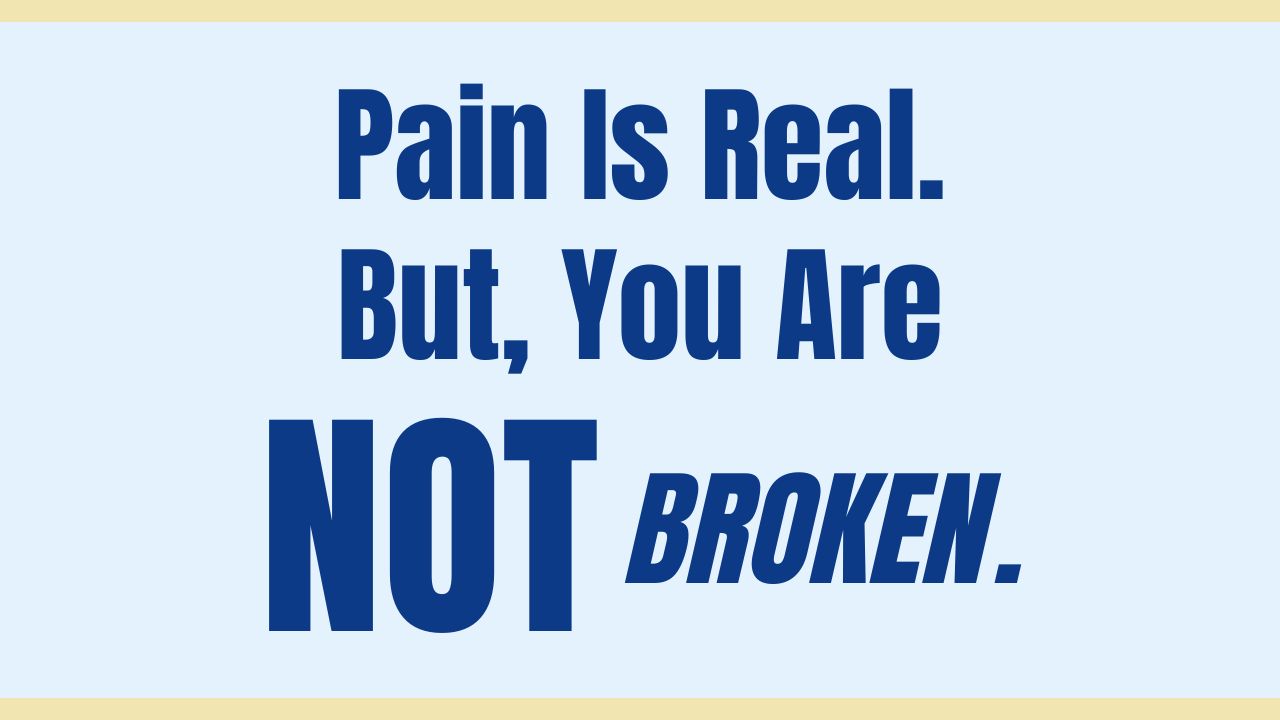
Pain is real.
But sometimes the way we relate to pain can keep us stuck.
The “fix me” trap
When pain lasts longer than expected, it is natural to start feeling frustrated, fearful, and even betrayed by your own body.
You may start thinking:
“What if something is seriously wrong?” “What if this never goes away?” “Why can’t anyone fix this?” “I must be fragile.” “I can’t trust my body anymore.”
Those thoughts are understandable.
But they can also become part of the problem.
Not because you are weak. Not because you are dramatic. But because your brain and nervous system are always listening.
If your nervous system believes your body is damaged, fragile, or unsafe, it may keep the pain alarm turned up. You may become more guarded. You may avoid movement. You may lose strength. You may lose confidence. And over time, your world can get smaller.
This is how pain can become more than a tissue problem.
It can become a protection problem.
Pain is an alarm, not always a damage meter
Pain is your body’s alarm system.
Sometimes that alarm is warning you about an injury that needs rest, treatment, or protection.
But sometimes the alarm stays sensitive even after the original tissue irritation has improved. Sometimes the body learns to protect an area too much. Sometimes normal movements start to feel threatening, not because they are dangerous, but because the nervous system has become overprotective.
That does not make the pain imaginary.
It means the system is sensitive.
And sensitive systems do not usually recover by chasing more and more passive fixes.
They recover by gradually relearning safety.
Where treatment fits
This is where hands-on care can be very helpful.
Manual therapy, chiropractic care, myofascial release, acupuncture, and other recovery-based treatments can all be useful tools.
They can help calm the nervous system.
They can reduce protective guarding.
They can improve movement.
They can decrease pain.
They can create a window where your body feels safer again.
That matters.
Relief matters.
But relief is not the final destination.
Relief is the doorway.
The goal is not for you to need someone to repeatedly “fix” you.
The goal is to use treatment to help calm the system enough that we can start building you back into someone who feels strong, capable, and confident again.
The body needs proof
You cannot simply think your way out of persistent pain.
You need experience.
Your body needs proof that it can move safely.
Your nervous system needs proof that load is not dangerous.
Your brain needs proof that you are not fragile.
Your tissues need repeated exposure to movement, strength, and capacity.
That is why exercise is so important.
A consistent movement and strength routine does not just change muscles, joints, tendons, and connective tissue.
It changes the brain.
It changes the story from: “I am fragile.” to: “I am becoming capable again.”
It changes the question from: “Who can fix me?” to: “What can I practice consistently that helps my body trust itself again?”
That shift is powerful.
This takes time
This is also why quick fixes usually are not enough.
If your nervous system has been protecting you for months or years, it usually needs more than one adjustment, one massage, one exercise, or one perfect explanation.
It needs repetition.
Most people start to feel the deeper benefits of a consistent movement routine after two to three months. Not always because every symptom is gone by then, but because something important starts to change.
They feel less afraid.
They move with more confidence.
They trust their body more.
They feel stronger.
They stop checking every sensation as a threat.
They start living more normally again.
That is often when recovery really begins to take hold.
The mindset shift
One of the most important shifts you can make is this:
Instead of asking only, “How do I make this pain go away?”
Start asking: “What is this pain asking me to practice?”
Maybe it is asking you to build strength.
Maybe it is asking you to move more consistently.
Maybe it is asking you to stop avoiding certain movements.
Maybe it is asking you to improve recovery, sleep, breathing, or stress.
Maybe it is asking you to stop seeing your body as broken.
This does not mean you ignore pain.
It means you stop letting pain become the whole story.
Pain is information.
It is not your identity.
You can have pain and still be healing
This is one of the most liberating things to understand:
You do not have to be pain-free before you start getting better.
You can feel discomfort and still be improving.
You can feel uncertain and still be building confidence.
You can feel symptoms and still be getting stronger.
You can have a sensitive nervous system and still train it to feel safer over time.
The goal is not to be reckless.
The goal is to learn the difference between pain that means danger and pain that means sensitivity, fear, guarding, or lack of capacity.
That is where guidance matters.
You should not have to figure this out alone.
Our goal
Our goal is not just to reduce pain.
Our goal is to help you become less afraid of your body.
We want to calm the nervous system.
We want to improve movement.
We want to help irritated tissues recover.
We want to build strength and resilience.
We want to help you understand what your pain means — and what it does not mean.
Most importantly, we want to help you move from passive coping to active recovery.
Not because treatment does not matter.
Treatment matters.
But the biggest breakthrough often happens when you realize that healing is not something someone else does to you.
It is something we help you participate in.
The bigger picture
Your pain is real.
But you are not broken.
Your body may be sensitive, guarded, irritated, or deconditioned. But it is also adaptable.
And with the right combination of treatment, movement, recovery, patience, and mindset, you can become more capable than you feel right now.
The goal is not to chase pain relief forever.
The goal is to build a body and brain that trust each other again.
