
Sports & Injury Rehabilitation in Kirkwood, MO
Whether you're getting back to the game or just want to garden, lift the grandkids, or sleep without pain, we start with hands-on care to calm things down, then build a step-by-step plan to get you stronger and harder to hurt again. No referral needed.

Sports & Injury Rehab at Our Kirkwood Clinic
At Embody, we think of rehabilitation as real training adapted to your injury. It's about building strength, improving movement, and developing physical capacity both in the injured area and throughout your body, with the goal of becoming more resilient overall.
Our chiropractic physicians and movement and strength coaches work together to create an individualized approach that considers your diagnosis, personal strengths, limitations, and goals. Whether you're recovering from an injury or dealing with persistent pain, we meet you where you are and help you progress at a pace that makes sense for you.
Your Rehabilitation Journey
Find the Right Starting Point
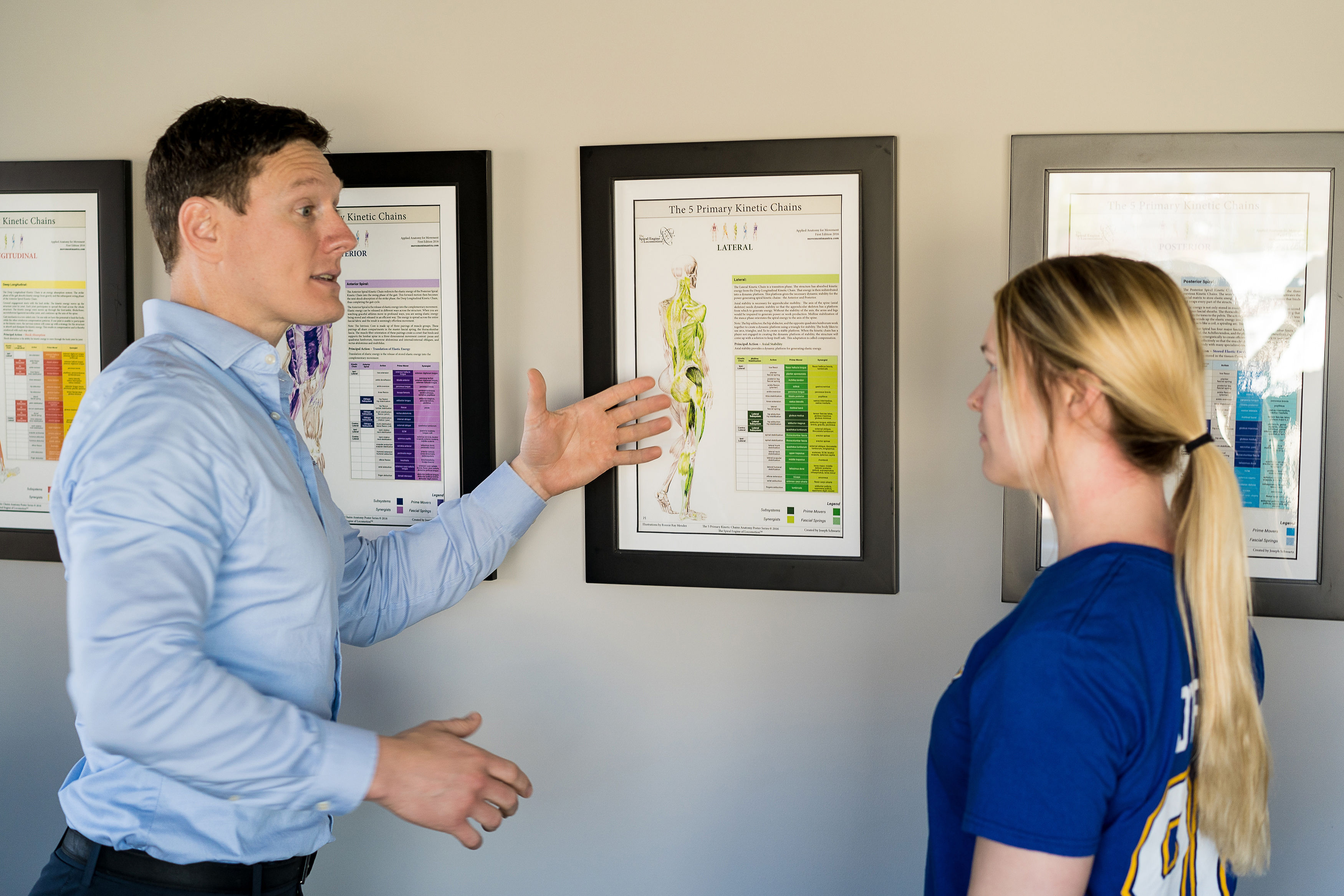
Most people start with an evaluation by one of our chiropractic physicians, especially if you're dealing with pain or a new injury. If you already know what's going on and mainly want guidance with exercise, you can start directly with a movement assessment with one of our coaches.
Personalized, One-on-One Rehabilitation
Rehabilitation typically begins with a package of six one-on-one sessions with a movement and strength coach. Your first session combines movement assessment with individualized exercises based on your needs, abilities, and goals. If you've been evaluated by one of our chiropractic physicians, their clinical findings and recommendations also help guide your program.
Where Rehabilitation Can Take You
Our goal isn't to keep you in rehab forever. It's to help you move forward.
Some people need a little guidance to get started. Others benefit from longer-term support. As you progress, we'll help you determine what makes sense for your goals.
- Continue independently: Build the knowledge, skills, and confidence to manage your exercises on your own.
- Continue rehabilitation: Additional one-on-one sessions can help you build on your progress when more guidance is needed.
- Progress into strength training: When you're ready, transition into ongoing one-on-one or small-group training to continue building strength, fitness, and resilience.
Success isn't measured by how long you stay with us. It's about helping you become more capable and confident in what your body can do.
Not sure where to start?
Request a free call and we’ll help you figure out the right first step
Rehab Built Around You
A diagnosis helps guide rehabilitation, but it doesn't tell the whole story. Two people with the same injury may have different strengths, limitations, movement abilities, and goals.
That's why we combine clinical findings with individualized movement assessments to build a program around your condition, current abilities, and personal goals.
Meeting you where you are
Exercises should meet you where you are while providing enough challenge to help you improve. We adjust difficulty, resistance, and complexity as your abilities change, making rehabilitation both accessible and progressively challenging.
Targeted Strengthening, Whole-Body Thinking
Depending on your condition, rehabilitation may involve strengthening the injured area directly, improving strength and movement elsewhere in the body, or a combination of both.
Building strength where it hurts
Sometimes, rehabilitation means directly strengthening the injured area. Muscles, tendons, and other tissues can adapt to the demands placed on them. With a tendon problem (tendinopathy), for example, rest alone often isn't enough to restore the capacity needed for daily activities or exercise. Gradually increasing the load placed on the tendon can help it become stronger and better able to tolerate physical demands. We apply the same principles of progressive strengthening used in effective exercise programs, adapted to your condition and current abilities.
Strengthening the areas around it
We also look beyond the painful area. Your body works as a connected system, and sometimes improving strength, mobility, or control elsewhere can support recovery. For example:
- Low back pain: Strengthening your hips, glutes, and core can help your back handle everyday activities like lifting, bending, and carrying.
- Knee pain: Building strength in your hips and thighs can help you feel more comfortable and capable with stairs, squats, and walking.
- Foot or ankle pain: Strengthening your hips and legs can help improve stability and control during walking, running, and other activities.
- Shoulder pain: Strengthening your upper back and the muscles around your shoulder blades can help support reaching, lifting, and overhead activities.
- Neck pain: Building strength and endurance in your shoulders and upper back can help you better tolerate the demands of work and daily life.
The goal isn't just to strengthen what hurts, but to build the overall capacity needed to move and function with confidence.
Rehabilitation vs. Physical Therapy: What's the Difference?
Physical therapy is a profession and a licensed title, while rehabilitation is the broader process of restoring function, rebuilding physical capacity, and helping people return to the activities that matter to them.
At Embody, our chiropractic physicians and movement and strength coaches collaborate to provide individualized rehabilitation through clinical evaluation, movement assessment, exercise coaching, and progressive strengthening.
What if you've tried physical therapy before without success?
Many physical therapists provide excellent, individualized care. However, we also hear from patients whose previous rehabilitation experiences didn't meet their expectations. Some describe exercises that weren't progressed, programs focused exclusively on one painful area, or limited individual attention.
If that sounds familiar, it doesn't mean rehabilitation can't help. A different approach—with more individualized coaching, ongoing reassessment, and appropriately challenging exercises—may be worth exploring.
The Gift of Injury: An Opportunity to Build Beyond Recovery
No one wants to get hurt, and even strong, well-prepared people do. An injury doesn't necessarily tell us what you did wrong. But it can teach us something about what to do next.
The injury itself isn't the gift. What you learn and build because of it can be. For some people, an injury is what finally gets them strength training. For others, it's a chance to understand how their body responds to stress, rest, and exercise.
Rehab isn't only about restoring function. It's also about restoring trust in your body. Pain can make anyone cautious, and the question becomes "What do I need to avoid?" Good rehab gradually shifts it to "What do I need to build so I can do this confidently again?"
That doesn't mean pushing through pain, or that more exercise is always the answer. Sometimes the body needs a reason to adapt. Sometimes it needs a chance to recover. Good care means knowing the difference.
And recovery doesn't always have to end at getting back to where you were. Sometimes, it's an opportunity to build greater strength, confidence, and resilience than you had before the injury.
Let's Find the Right Next Step for You
Whether you're dealing with persistent pain, recovering from an injury, or simply want to move more comfortably, we're here to help. Schedule an appointment, and let's figure out the right next step together.
We’re self-pay with straightforward pricing, accept HSA and FSA cards, and provide superbills for out-of-network reimbursement.


